
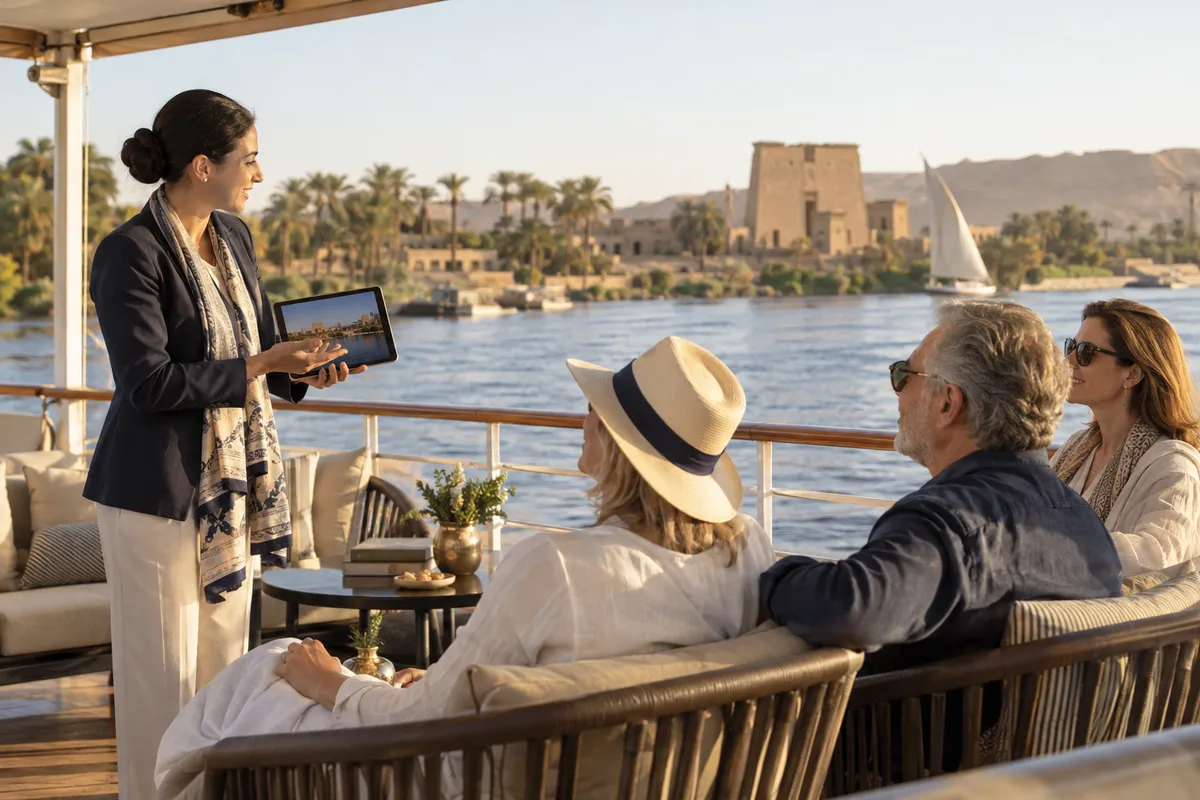
Travel advisor Michael Consoli was named godfather of Viking Sekhmet, Viking's new ship on the Nile, and he chose to share the moment with his clients through a video, according to TravelPulse. If you're a Gen Z traveler who books everything yourself, that detail is worth a second look. It shows what a good advisor relationship looks like, and it gives you a checklist for deciding whether you want one on your next big trip.
What happened with Viking Sekhmet
Per TravelPulse, Consoli, described as a top Viking Cruises advisor, received the godfather title for the Viking Sekhmet. Instead of keeping the honor to himself, he shared it with clients in a video that highlighted their support. The report says Consoli praised Viking for its luxury offerings and its strong partnership with advisors, and noted demand for culturally immersive experiences.
A ship's godparent is a ceremonial role, and the details of the ceremony aren't in the TravelPulse report, so I won't guess at them. What stands out is the choice to credit the people who booked.
Why the client video is the real story
Most of us assume advisors are for retirees with a spare month and a big budget. This story pushes against that. An advisor who treats a career milestone as something his clients helped build is signaling a relationship, not a transaction.
That's my read, not something the report states. But it's a useful lens when you're shopping for help.
Questions to ask any advisor before you commit
- Do they talk about specific past trips and clients, or just generic brochures?
- Do they have a real relationship with the cruise line or tour operator they're recommending?
- Will they tell you when something isn't a fit for you?
None of that comes from the article. It's simply what the story made me want to ask.
Why the Nile fits the moment
TravelPulse frames this as part of a broader move toward culturally immersive travel, and Consoli noted demand for exactly that. Egypt is an obvious example. The Nile is a destination where the point is the context: the history, the places, the pace of moving along the river rather than flying between sights.
If you're a digital nomad used to slow travel, a river cruise is an interesting contrast. You unpack once and the destination comes to you. I'd check the specifics of any itinerary directly with Viking or an advisor, since the report doesn't detail routes, prices, or ship features.
Viking's pitch: luxury plus immersion
The report underscores Viking's luxury positioning and its focus on cultural immersion. For younger travelers, the takeaway is that premium doesn't have to mean generic. The appeal described here is depth of place, not just nice amenities.
Should you use an advisor for a trip like this?
Here's a practical way to decide.
- Use one if the trip is complex, expensive, or in a region where logistics matter. Egypt fits that description in my view.
- Skip one if you're doing a flexible, low-cost trip where you enjoy the research.
- Try a hybrid: research your own shortlist, then have an advisor pressure-test it.
The takeaway
Before your next big trip, ask a potential advisor one thing: who have they sent where, and what did those clients say afterward? The answer will tell you more than any title ever could.